
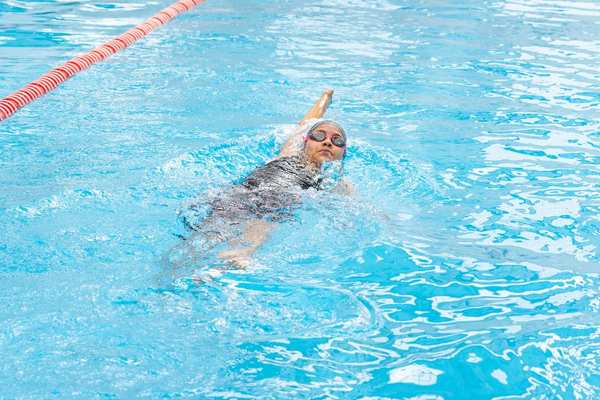
Backstroke can look effortless from the pool deck, but fast backstroke swimming is built on small, coordinated decisions. Where your head sits affects your hips. How your torso rotates changes the angle of your catch. And a good turn can save time that no amount of frantic arm movement will recover. The goal is not simply to move your arms faster. It is to travel farther with each effective stroke while maintaining a rhythm you can sustain.
Find a Body Position That Lets You Glide Forward
Start with a long, nearly horizontal line. Keep your ears in the water, look generally upward, and allow your head to remain quiet as your shoulders move. Your hips should ride close to the surface rather than sinking into a seated position. Think of your chest and hips travelling together, not your upper body towing your legs.
Rotate the Torso Without Rocking the Head
Effective backstroke technique involves rotation around the body’s long axis. Your hips and shoulders roll together as one arm enters and the other finishes its pull. This creates room for the underwater arm to hold water and helps the recovering arm clear the surface.
A useful starting cue is roughly 30–45 degrees of rotation to either side, although the best amount varies with mobility, speed and individual mechanics. Do not force a rigid angle. If your head rolls from side to side, or your legs begin to snake across the lane, scale the movement back.
Build a Compact, Continuous Backstroke Kick
The backstroke kick helps maintain balance, supports the hips and adds propulsion. Kick from the hips with relatively small, alternating leg movements. Let the knees flex naturally rather than locking the legs straight, and keep your ankles loose so the feet can move water effectively.
Try a 25-metre kick on your back with your arms by your sides. Keep your face steady and notice whether your hips stay high. Then repeat with your arms streamlined overhead. The second length is harder because it exposes weaknesses in alignment. For more focused practice, a dedicated backstroke kick drills session can help develop control before adding the arm stroke.
Make the Backstroke Pull Work Underwater
Entry and Catch
Recover each arm over the water in a relaxed, controlled path. Enter in line with the shoulder, rather than crossing over behind your head. A little-finger-first entry can help set up a smooth transition, but the real objective is a clean entry followed by a useful catch.
Once the hand enters, let it travel to a position where the hand and forearm can press water toward your feet. Bend the elbow as you establish that hold. Avoid immediately sweeping sideways or pushing down, which wastes effort without moving you effectively along the lane.
Power and Exit
During the backstroke pull, maintain pressure on the water as the hand travels past the shoulder and toward the hip. Your rotating torso supports the motion; the arm should not operate as an isolated lever. Finish without pausing beside the thigh, then let the hand exit cleanly for recovery.
Coordinate Arms, Rotation and Breathing
Backstroke swimming gives you access to air throughout the stroke, but that does not mean breathing should be random. Breathe in a steady pattern, such as inhaling during one arm recovery and exhaling during the other. The exact rhythm matters less than avoiding breath-holding and keeping your face relaxed.
As one arm catches, the other is finishing its push and preparing to recover. Aim for a continuous exchange, not a long pause with both arms inactive. Swimmers chasing speed sometimes spin their arms while losing their catch. If your stroke rate rises but your distance per stroke collapses, restore pressure on the water before increasing tempo.
Use the Start and Backstroke Turns to Protect Your Speed
In competition, backstroke begins in the water with swimmers facing the starting wall. A forceful push, tight streamline and controlled underwater kicks help carry speed into the first surface strokes. Your head must break the surface by the 15-metre mark after the start and each turn under World Aquatics rules. More underwater distance is not automatically better if your speed fades before you surface.
Approaching and Executing the Turn
The overhead backstroke flags are a reference for approaching the wall, not a universal instruction to take a set number of strokes. Count your own strokes from the flags at training speed, then rehearse at race speed because your count may change.
For a standard backstroke flip turn, time the final approach so you rotate toward your front and use an immediate, continuous permitted arm pull to initiate the somersault. Touch the wall with a part of your body during the turn, plant your feet and leave the wall on your back. Avoid rolling onto your front early and gliding toward the wall, which can compromise both speed and legality.
At the race finish, touch while on your back. Current World Aquatics rules permit complete submersion on the finish approach once the head has passed the final five-metre mark, but that does not remove the requirement to finish on the back. Practise a decisive final reach rather than guessing at the wall.
A Practical Set to Diagnose Your Stroke
Try four 25-metre repeats with adequate rest: one focused on head and hip alignment, one on compact kicking, one on shoulder-width entry and underwater catch, and one combining all three at a controlled fast pace. Record your time and count arm strokes on the final repeat. Repeat the set later and look for similar or better speed without extra strokes or visible wobbling.
For a broader comparison, review freestyle body position and underwater dolphin kick technique alongside your backstroke practice. The body-line principles overlap, but the orientation, catch and timing demands are distinct.
Frequently Asked Questions
What is the most important part of backstroke technique?
Body alignment is the foundation. A stable head, high hips and coordinated rotation allow your kick and pull to produce forward movement without fighting avoidable drag.
Should my knees come out of the water during backstroke kick?
They generally should not pop high above the surface repeatedly. Aim for a compact kick driven from the hips, with natural knee movement and relaxed ankles.
How much should I rotate during backstroke?
A moderate roll is useful, often around 30–45 degrees as a coaching reference. Your effective range depends on flexibility and stroke timing; keep the head steady and avoid excessive rolling.
How far can I swim underwater after a backstroke turn?
In World Aquatics competition, your head must break the surface by 15 metres after each turn and after the start. You can surface earlier when it helps preserve speed and rhythm.
Bring the Pieces Together
Better backstroke comes from coordination rather than one dramatic correction. Hold a clean body line, kick without excessive knee lift, set an effective catch and rotate smoothly from side to side. Then treat every wall as part of the race, not a break between lengths. Refine one element at a time and let the improvements accumulate into faster, more controlled swimming.